
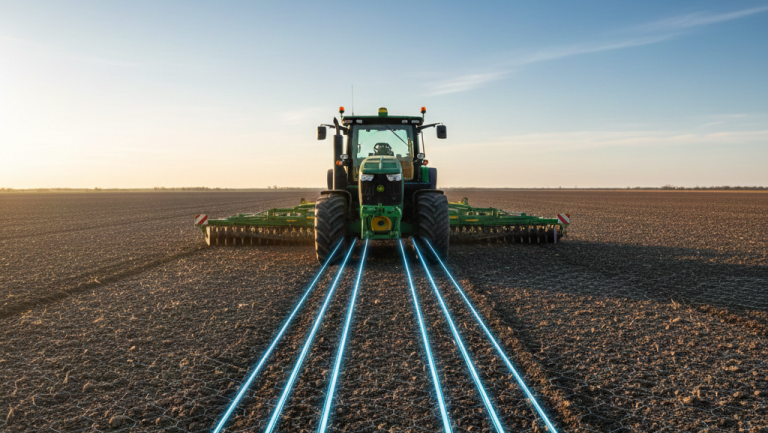
72% of farms adopting RTK-based auto steering systems in 2025 reported measurable reductions in overlap and input costs.
- RTK positioning accuracy: ±2.5 cm, suitable for seeding and row-based operations
- Overlap reduction: typically 7%–10% compared with manual steering
- Input cost reduction: more than 5% in fertilizer and pesticide usage
- Operating speed range: 0.3 km/h to 15 km/h depending on field conditions
- Signal system: GNSS multi-constellation support for stable positioning
- Sensor integration: IMU provides motion tracking during short GNSS interruptions
- Field coverage: consistent path tracking reduces missed areas during operation
- Labor impact: reduced operator workload during long working hours
An auto steering system is a tractor guidance technology that uses RTK positioning and onboard sensors to control steering automatically.
The system follows predefined paths such as straight lines or curves with centimeter-level accuracy.
GNSS provides real-time positioning data for field navigation.
IMU data ensures continuous guidance when GNSS signals are unstable.
The combination of GNSS and IMU improves path consistency across different terrains.
Auto steering systems are used in seeding, spraying, and fertilizing operations.
Precise path control reduces overlap and prevents skipped rows.
Consistent steering improves field efficiency and reduces input costs.
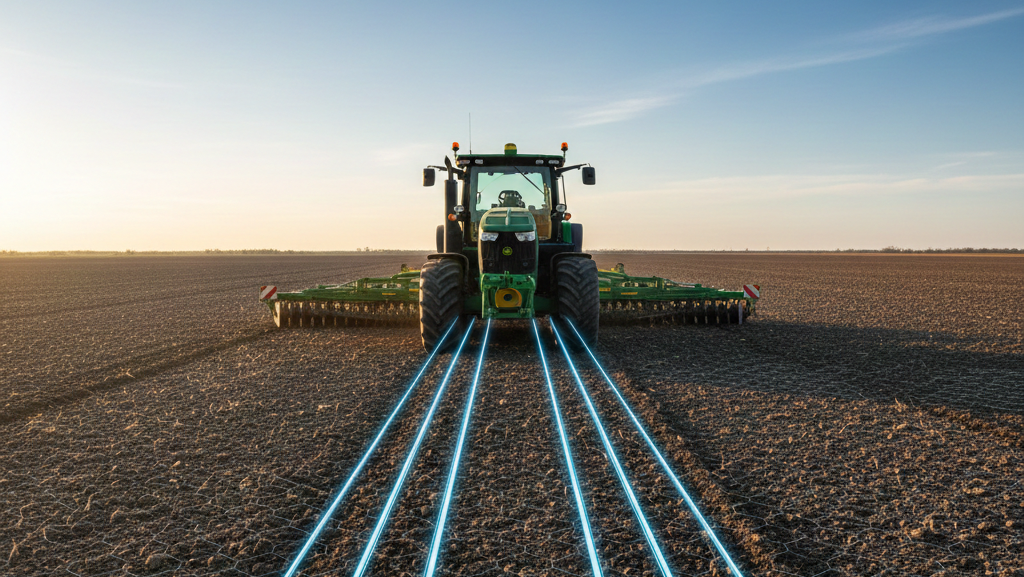
Tractor equipped with AGMA-Toyar auto steering system working with ±2.5cm accuracy
Common Problems with Manual Tractor Steering
- uneven row spacing
- repeated overlap in spraying
- missed areas during seeding
- operator fatigue after long working hours
What Is an Auto Steering System?
An auto steering system is a tractor guidance technology that uses RTK positioning and onboard sensors to automatically control steering and follow predefined paths.
By following predefined routes such as straight lines or curves, the system ensures:
- Accurate field coverage
- Reduced overlap and skips
- Consistent operation even at night or in low visibility
This is why auto steering is becoming a core component of modern precision agriculture.
Why Precision Agriculture Needs Auto Steering
Manual driving may seem simple, but even small steering errors can lead to repeated overlap, increasing input costs over time.
With an auto steering system, farms can achieve:
- Up to 5 cm accuracywith RTK precision positioning
- Improved efficiency in seeding, spraying, and fertilizing
- Reduced operator fatigue during long working hours
Compared with manual steering, auto steering systems can significantly reduce overlap and improve consistency across field operations.
Key Benefits of an Auto Steering System
1. Higher Land Utilization
By eliminating overlaps and skips, an auto steering system can increase land utilization by 7%–10%.
2. Lower Input Costs
With precise path control, farmers can reduce pesticide and fertilizer usage by over 5%.
3. Faster Operations
Consistent guidance allows tractors to operate efficiently at speeds from 0.3 km/h to 15 km/h.
4. Reduced Driver Fatigue
Automated steering significantly reduces manual effort, especially during long working hours.
How an Auto Steering System Maintains Accuracy
A typical auto steering system combines GNSS satellite positioning with IMU (inertial measurement unit) data to achieve stable and continuous guidance.
GNSS provides real-time position coordinates based on satellite signals, while the IMU tracks the tractor’s motion, including direction, tilt, and acceleration. By integrating these two data sources, the system can:
- Maintain accurate positioning during short GNSS signal interruptions
- Compensate for terrain changes such as slopes or uneven ground
- Ensure smooth and consistent steering control in real field conditions
This combination allows the system to deliver reliable performance even in environments where satellite signals may be temporarily unstable.
For example, the AGMA-Toyar JHXH001 auto steering system uses a multi-sensor fusion algorithm that integrates GNSS and IMU data in real time. This enables:
- Stable accuracy within ±2.5 cm under RTK conditions
- Continuous operation during brief signal loss
- Automatic terrain compensation for improved field consistency
As a result, the system performs reliably across different farming scenarios, including seeding, spraying, and fertilizing, where consistent path accuracy is critical.
Built for Real Farming Conditions
Key Hardware Specifications
- Display Terminal (DP10A)
1-inch high-brightness screen (750 nits), clearly visible under sunlight - Electric Steering Motor (ASM07-100A)
High torque output (7Nm rated, 13Nm max) for responsive control - GNSS Antenna (NGP300)
Supports multi-constellation tracking for stable RTK precision positioning - Durability
Designed for harsh agricultural environments:
- Waterproof
- Dustproof
- Shock-resistant
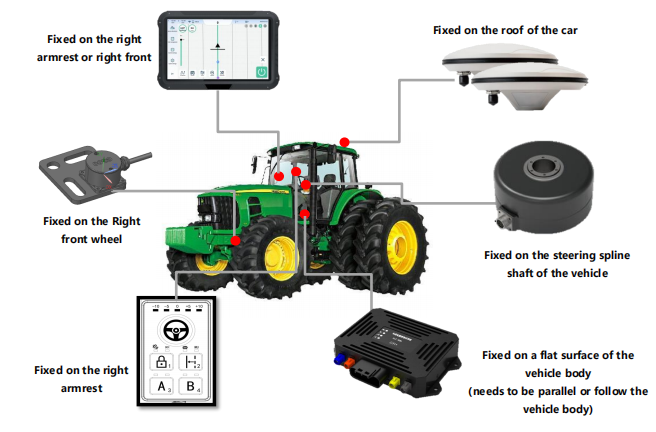
JHXH001 auto steering system hardware: DP10A terminal, ASM07-100A motor, and NGP300 antenna
Easy Installation & Strong Compatibility
The JHXH001 auto steering system is designed for fast deployment and flexibility.
- Installation time:30–60 minutes
- Wide voltage support:9–36V
- Compatible with most tractor brands
- No complex hydraulic modifications required
This makes it ideal for both new and older tractors.
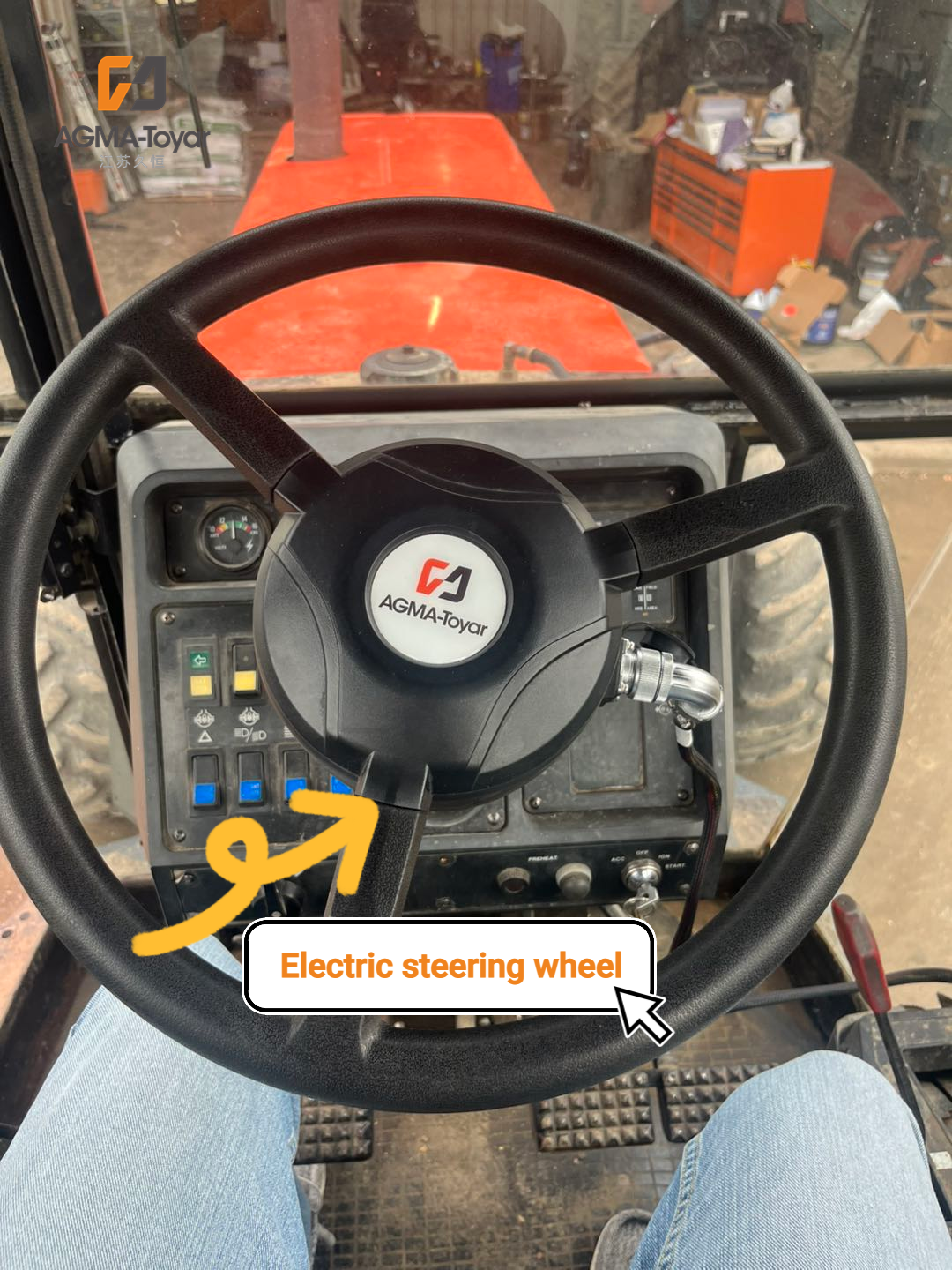
Easy installation of electric steering motor on a standard tractor steering column
ROI: How Much Can You Save?
By combining efficiency and precision, the system delivers clear financial benefits:
- 7%–10% higher land utilization
- 5%+ reduction in input costs
- Average annual savings of around 20,000 RMB per unit, depending on farm size and operation frequency
For many farms, the investment pays for itself quickly.
FAQ: Auto Steering System for Tractors
Q1: How does an auto steering system work on a tractor?
It uses RTK precision positioning and sensors to guide the tractor along preset paths, ensuring consistent and accurate operation.
Q2: Can it be installed on older tractors?
Yes. The system supports retrofitting and is compatible with most tractor models.
Q3: What happens if GNSS signal is lost?
The system continues operating using a combined navigation algorithm, maintaining accuracy during short interruptions.
Q4: Is it suitable for different farming tasks?
Yes. It supports seeding, spraying, fertilizing, and other applications in precision agriculture.
Q5: What accuracy is required for precision farming?
The required accuracy in precision farming depends on the specific agricultural task:
- Basic operations (tillage, spreading):15–30 cm accuracy is usually sufficient
- General fieldwork (spraying, fertilizing):5–10 cm accuracy improves efficiency and reduces overlap
- High-precision tasks (seeding, planting):2–3 cm accuracy is required to ensure consistent row spacing
For most modern farming operations, especially planting and row crops, RTK-level accuracy (±2.5 cm) is considered the standard. This level of precision helps reduce input waste, avoid missed areas, and maintain uniform crop growth.
Q6: Is RTK necessary for auto steering systems?
RTK is not always required, but it is essential for high-precision farming applications.
Auto steering systems can operate using different positioning methods:
- Standard GPS:1–3 meters accuracy, suitable for basic tasks
- DGPS:20–50 cm accuracy, suitable for some spraying applications
- RTK (Real-Time Kinematic):±2.5 cm accuracy, required for seeding and precision row farming
Without RTK, auto steering systems may still reduce operator fatigue, but they cannot reliably prevent overlap or skipped rows in precision agriculture.
For tasks like planting, strip-tilling, or controlled traffic farming, RTK is strongly recommended to achieve consistent and repeatable results.
Upgrade Your Farm with Agricultural Automation
As precision agriculture continues to evolve, adopting an auto steering system is a practical way to improve operational efficiency and reduce input costs.
The AGMA-Toyar JHXH001 helps reduce fertilizer and pesticide usage by over 5% while maintaining consistent field accuracy for farms adopting agricultural automation.
👉 Contact us today to learn more or request a customized solution.

