
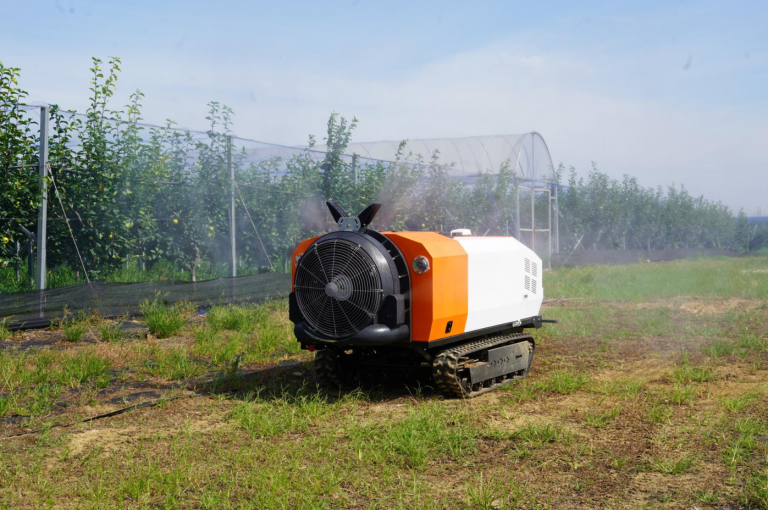
How can an orchard sprayer improve precision and coverage?
A modern orchard sprayer should do more than carry liquid and discharge it through nozzles. It should help operators maintain consistent application, reduce unnecessary spraying, work safely on uneven ground and cover the orchard canopy effectively.
Our 1200L Smart Tracked Orchard Sprayer with RTK Autonomous Navigation is designed around that requirement. It combines a self-propelled crawler chassis, RTK centimeter-level positioning, ultrasonic target detection, 10-channel PWM variable-rate control and an air-assisted spray system. Together, these systems support a more targeted approach to orchard plant protection in orchards, gardens, hilly terrain and greenhouses.
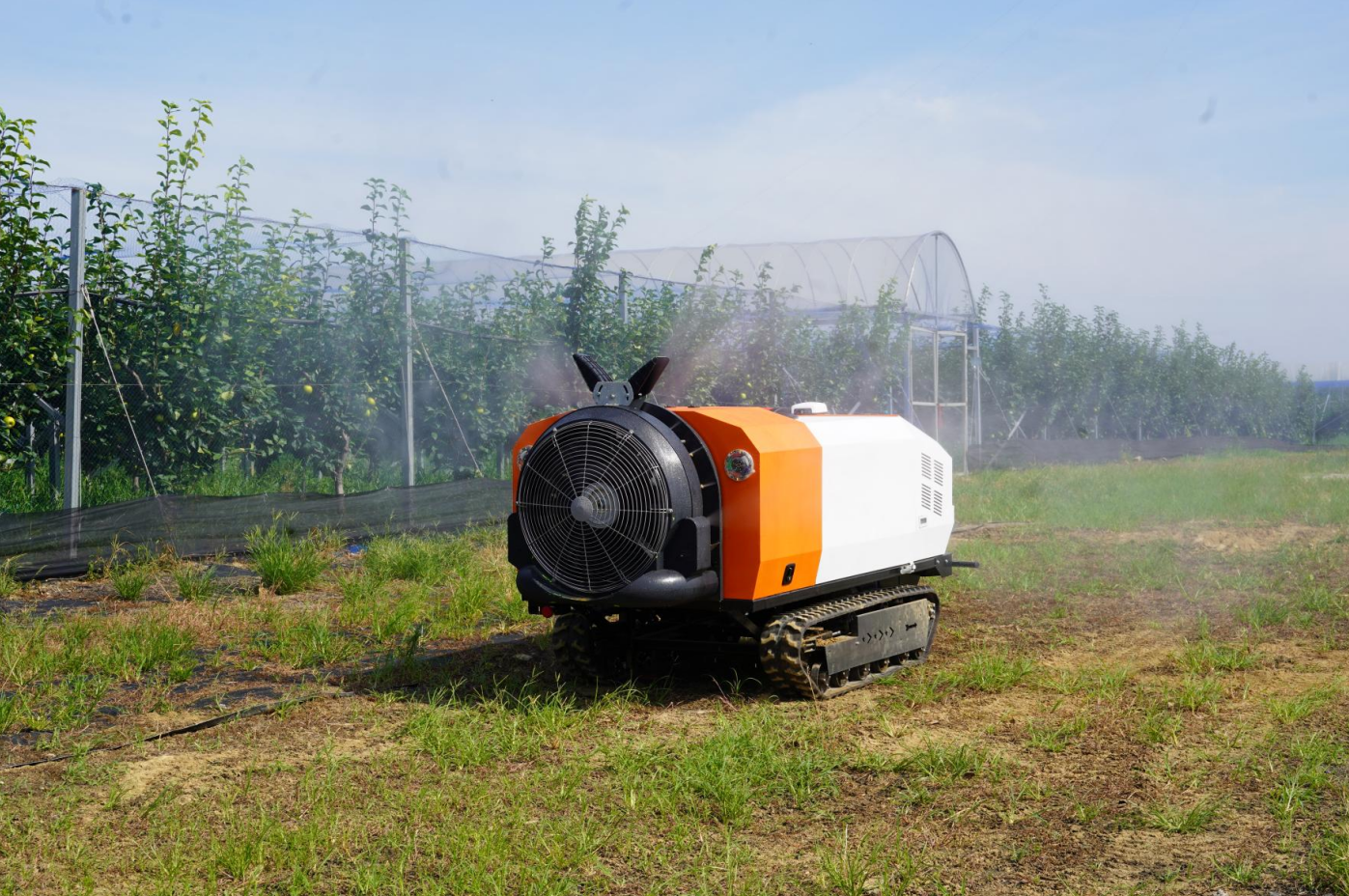
Planning a precision spraying project? Request a quotation for the 1200L Smart Tracked Orchard Sprayer and share your orchard size, row spacing, terrain and target market.
Why is precision spraying important in modern orchards?
Conventional spraying can create several operational problems:
- Spray may be applied where there is little or no canopy.
- Uneven travel speed can cause inconsistent dosage per hectare.
- Dense foliage can make it difficult for spray droplets to reach the inner canopy.
- Slopes and irregular ground can increase operator workload.
- Repeated manual steering can make it difficult to follow the same route accurately.
Precision agriculture technologies address these issues by matching field movement, spray output and crop conditions more closely. The USDA Agricultural Research Service overview of precision agriculture describes guidance and variable-rate technology as ways to improve application precision, reduce overlaps and gaps, and improve economic and environmental efficiency.
In orchard systems, the objective is targeted application: deliver the appropriate amount to the canopy, follow a repeatable route and minimize unnecessary loss.
How does RTK autonomous navigation work on this orchard sprayer?
The machine supports field mapping and autonomous path planning through the H12 remote control and autonomous app. A typical workflow is:
- Create the field boundary.
- Set the working width, safety margin and maximum speed.
- Mark four boundary points.
- Select the working edge.
- Let the system generate a spray path.
- Deploy the path and switch to autonomous mode.
- Allow the variable-rate system to start automatically during operation.
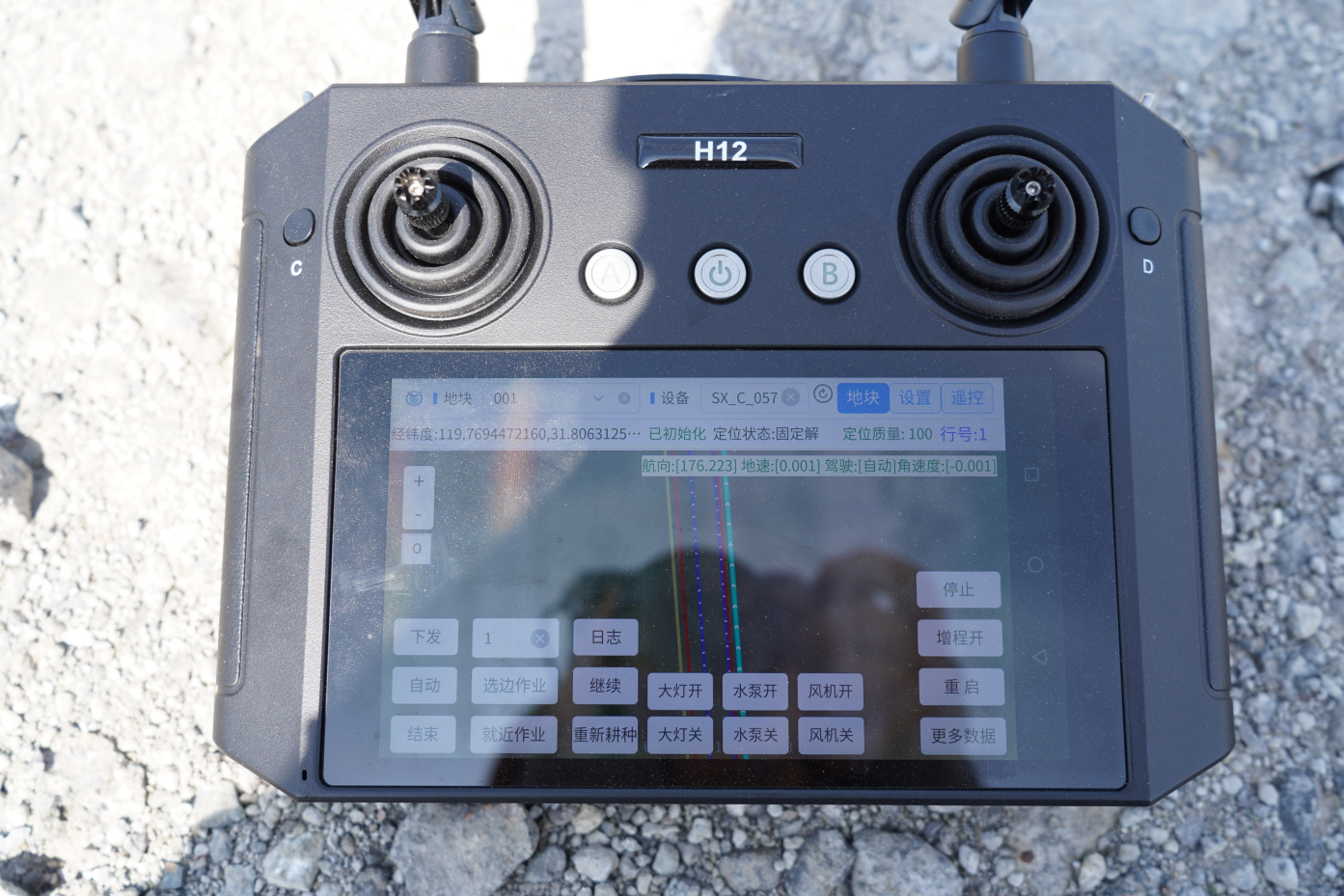
The app uses RTK centimeter-level positioning for field mapping and autonomous route planning. This is especially useful when the machine must follow orchard rows repeatedly or operate in larger fields where manual steering can create unnecessary overlap or missed areas.
The operator can also use the H12 remote control for direct operation. Its display can show battery voltage, travel speed, fan speed, pump pressure, spray flow rate and dosage per hectare. The effective control range is up to 200 meters.
What makes the 1200L tracked orchard sprayer different?
1. A tracked chassis for orchard and sloped terrain
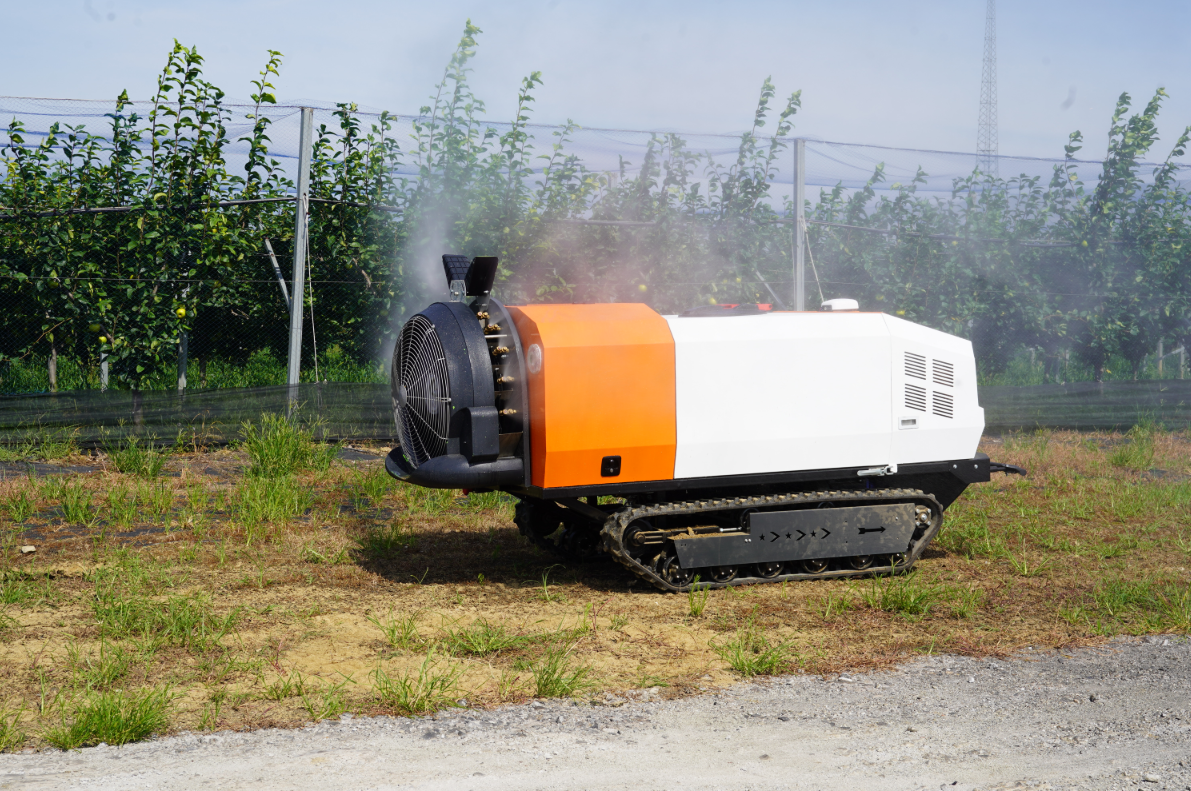
The self-propelled dual-crawler chassis is designed for orchard work, gardens, hilly terrain and greenhouse applications. The chassis supports a maximum climbing angle of ≤25°. For downhill travel, the operating manual specifies low-speed straight-line driving; sharp turns and high-speed coasting on slopes are prohibited.
A tracked platform provides a stable machine configuration for uneven orchard terrain and helps the sprayer maintain mobility where wheeled equipment may be less suitable.
2. Ultrasonic target detection
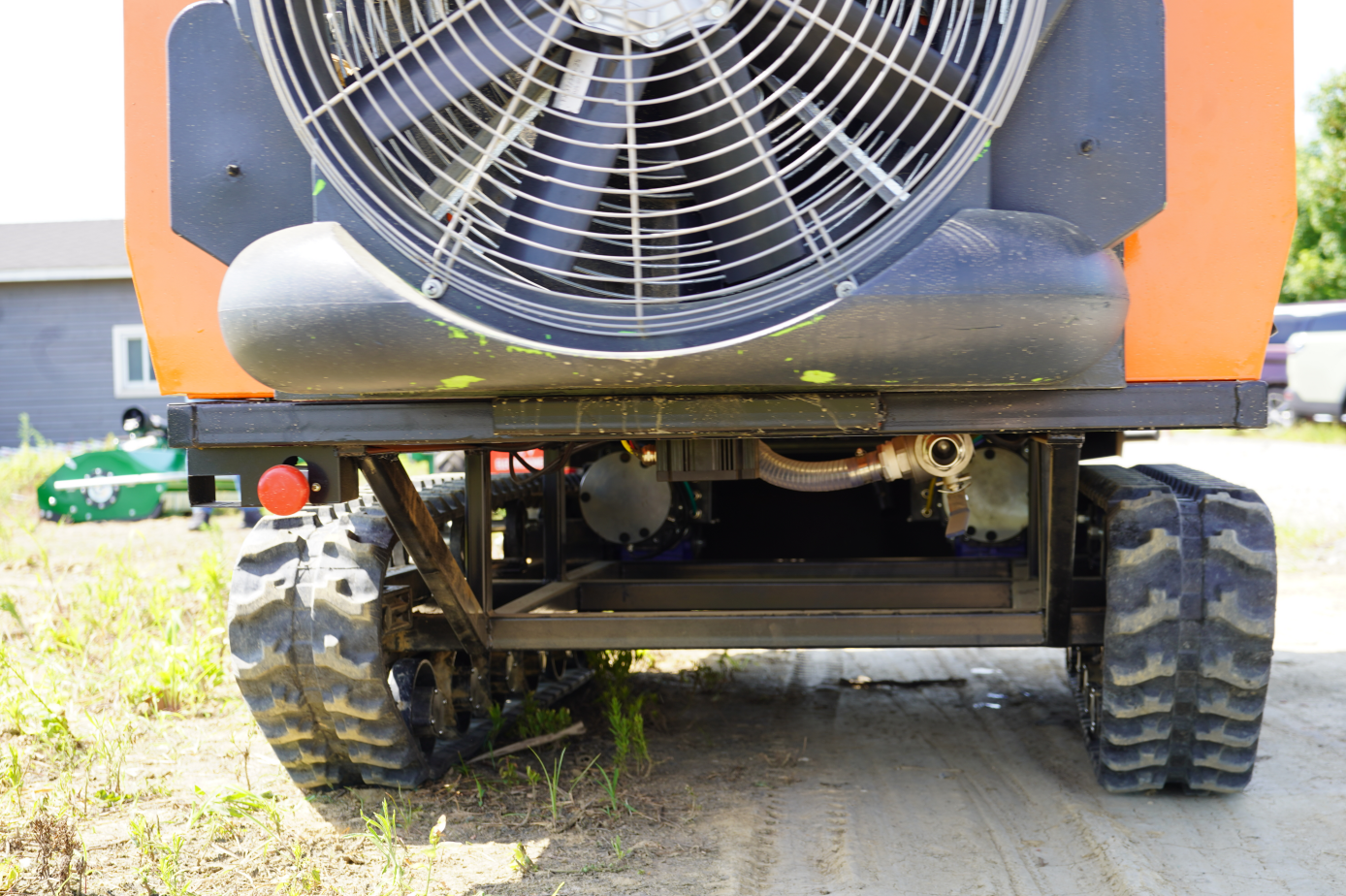
The ultrasonic target detection system identifies canopy presence during operation. When the system detects a gap without tree cover, it can stop spraying in that area. This helps reduce ground waste and unnecessary application between trees.
This feature is particularly relevant for orchards with irregular tree spacing, gaps in rows or changing canopy density. The machine responds to the presence of the target instead of applying the same output continuously across every open space.
3. Ten-channel PWM variable-rate spraying
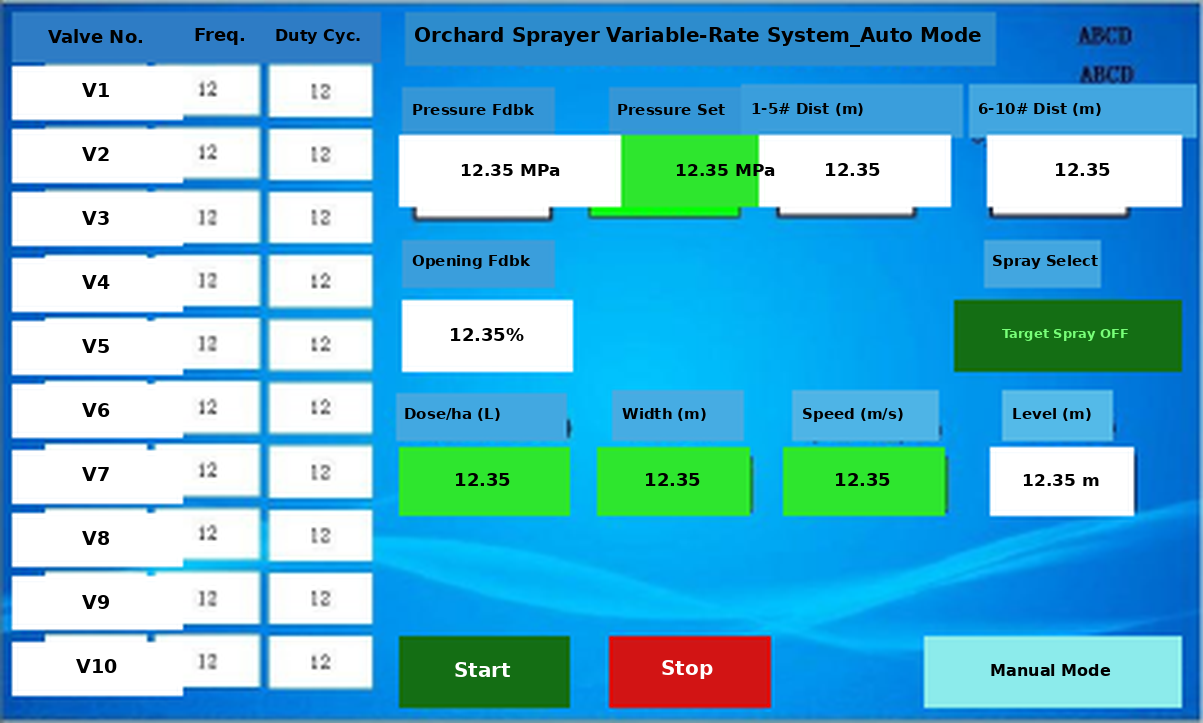
The sprayer uses 10 independently controlled high-frequency PWM solenoid valves. The variable-rate system can allocate dosage more precisely according to canopy density and operating conditions.
Our integrated precision variable-rate spraying system targets a 30–70% pesticide-saving range compared with conventional spraying by responding to canopy presence and density. Actual savings depend on crop type, canopy structure, tree spacing, chemical formulation, weather, calibration, travel speed and operating settings.
4. Speed-based flow adjustment
Travel speed affects how much liquid is applied to a given area. The sprayer’s control system connects travel speed with spray flow so that dosage per hectare can remain more consistent when speed changes.
This is valuable on uneven or hilly ground, where maintaining exactly the same speed manually can be difficult. The H12 display shows real-time flow and dosage information, helping operators monitor application during work.
5. Air-assisted delivery for canopy penetration
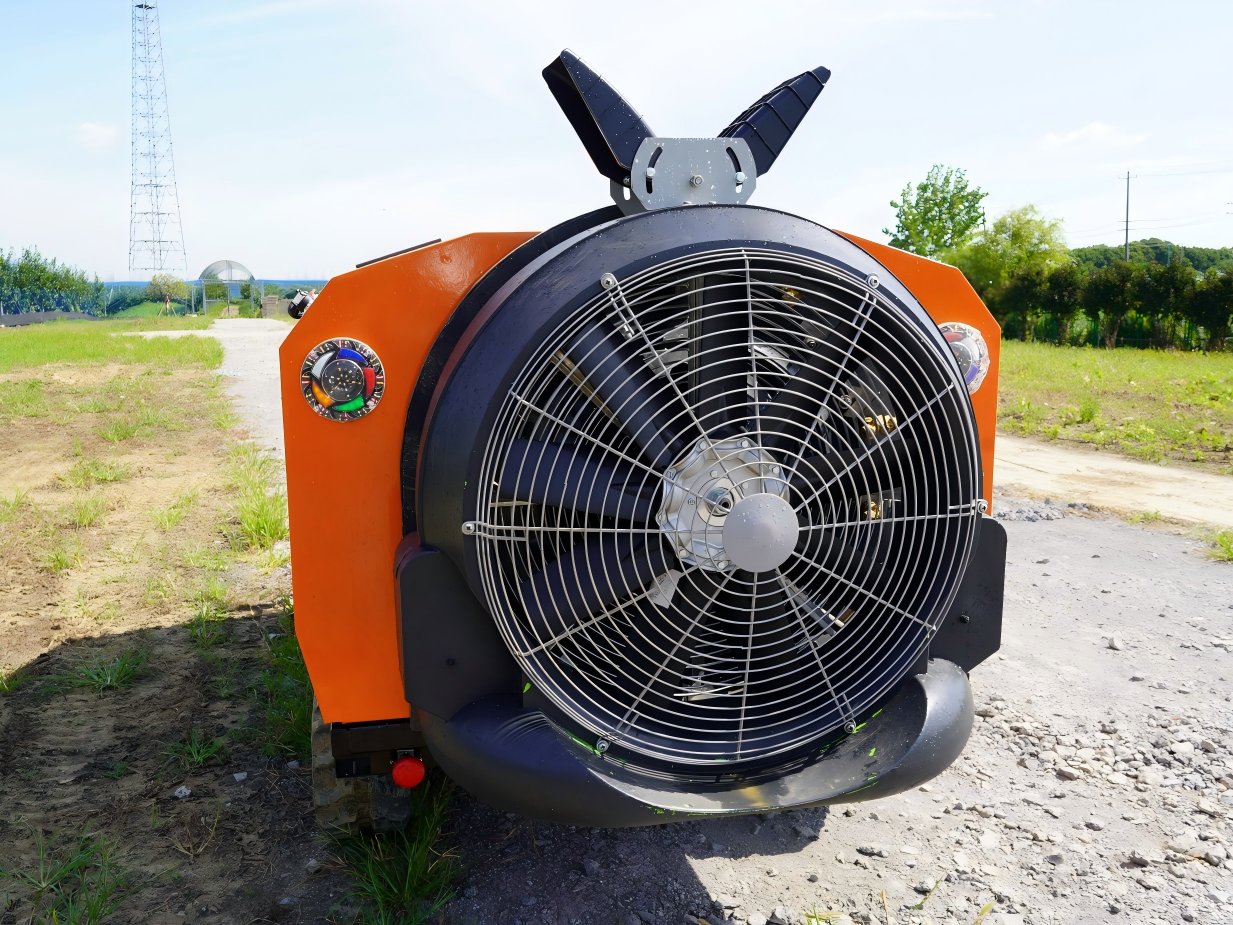
The air-assisted spray unit uses a 680 mm nine-blade fan with an adjustable directional air duct. The fan motor is specified at 6 kW rated power.
Air assistance helps move spray toward the canopy and can support coverage from the outer leaves toward the inner canopy. Airflow and spray settings should be matched to the crop, canopy density, row spacing and application product.
6. Dual power system for field operation
The machine combines:
- A 72V LiFePO4 battery for electric operation.
- A diesel range-extender generator set for continued operation and battery charging.
- A generator output specified at 14.4 kW rated and 16 kW peak.
This dual-power design combines quiet electric drive with a diesel range extender for continued field operation. The operating manual requires trained operators, a minimum 5-meter exclusion zone for bystanders, and full power-off before maintenance, refueling or work on the pump, fan or variable-rate system.
Key specifications at a glance
| Specification | Product information |
|---|---|
| Tank capacity | 1,200 L |
| Machine type | Self-propelled tracked orchard sprayer |
| Overall dimensions | 3,220 × 1,350 × 1,680 mm |
| Machine weight | 1,500 kg machine self-weight |
| Navigation | RTK centimeter-level positioning with APP autonomous navigation |
| Spray control | 10-channel high-frequency PWM control with ultrasonic target detection, pressure sensing and liquid-level sensing |
| Fan | 680 mm, nine-blade fan |
| Fan motor | 72V DC brushless motor, 6 kW rated power |
| Pump | Italian imported diaphragm pump |
| Pump motor | 72V permanent-magnet synchronous motor, 4 kW |
| Battery | 72V 105SH LiFePO4 battery |
| Range extender | WS2V95F air-cooled, two-cylinder V-type, four-stroke direct-injection diesel engine |
| Engine displacement | 1,247 mL |
| Generator output | 72V DC, 14.4 kW rated / 16 kW peak |
| Maximum climbing capability | ≤25° |
| Downhill operation | Low-speed straight-line driving; sharp turns and high-speed coasting prohibited |
| Remote-control range | ≤200 m |
| Safety operation | Trained operator required; keep bystanders at least 5 m away; power off before maintenance and refueling |
| Warranty | 1 year |
| Certifications listed | CE, ISO and SGS |
Who is this smart orchard sprayer suitable for?
Orchard owners and growers
The machine is suitable for growers evaluating autonomous route planning, canopy-responsive spraying and reduced operator workload. Before purchasing, growers should prepare details such as orchard acreage, crop type, row spacing, canopy height, slope and current spraying method.
Agricultural machinery importers and distributors
The combination of RTK navigation, tracked mobility, variable-rate spraying and dual power gives importers and distributors a differentiated smart-agriculture product. We offer OEM/ODM customization for different market requirements.
Agricultural engineering companies
Engineering partners can evaluate the machine as part of a broader precision-agriculture project. Important integration questions include field mapping, operating boundaries, safety procedures, local compliance, maintenance support, chemical compatibility and data requirements.
1200L smart tracked orchard sprayer vs. conventional spraying
| Evaluation area | Conventional spraying approach | 1200L smart tracked orchard sprayer |
|---|---|---|
| Route control | Often depends heavily on manual steering | RTK-assisted mapping and autonomous path planning |
| Spray in canopy gaps | May continue unless manually controlled | Ultrasonic detection can stop spraying in gaps |
| Dosage consistency | Can vary with travel speed | Speed-based flow adjustment supports consistent dosage per hectare |
| Canopy coverage | Depends on nozzle setup and operator technique | Air-assisted delivery supports movement into dense canopy |
| Terrain operation | Depends on vehicle type and operator control | Tracked chassis with specified climbing capability up to ≤25° |
| Operating information | May require separate observation or records | H12 display shows speed, pressure, flow and dosage information in real time |
| Power configuration | Commonly engine-driven | 72V battery plus diesel range extender |
What information should buyers include when requesting a quotation?
To receive a more useful recommendation, include the following information in your inquiry:
- Crop and orchard type: for example, citrus, apple, grape, stone fruit or mixed orchard.
- Total area: hectares or acres to be treated.
- Row spacing: distance between rows and approximate turning space.
- Canopy height and density: average and maximum values.
- Terrain: flat, sloped, terraced, muddy or uneven.
- Target market: destination country and any local machinery requirements.
- Purchase role: orchard owner, distributor, importer or engineering contractor.
- Customization needs: branding, software, control, power, spray configuration or documentation.
- Expected delivery and support: installation guidance, spare parts and after-sales requirements.
These details help us prepare a more relevant configuration, shipping and support proposal.
Frequently asked questions
What is a 1200L smart tracked orchard sprayer?
It is a self-propelled tracked crop-protection machine with a 1,200-liter tank. This model combines RTK autonomous navigation, air-assisted spraying, ultrasonic canopy detection and PWM variable-rate control.
Can the sprayer work autonomously?
Yes. The product supports boundary mapping, automatic path generation and autonomous operation through the navigation system and app. The H12 remote control also supports manual operation and monitoring.
How much pesticide can it save?
Our integrated precision variable-rate spraying system targets a 30–70% pesticide-saving range compared with conventional spraying by stopping spray in canopy gaps and adjusting application according to canopy density and travel speed. Actual savings depend on crop type, canopy structure, tree spacing, chemical formulation, weather, calibration and operating settings.
Is it suitable for hilly orchards?
The tracked chassis is designed for orchard and hilly-terrain applications, with a maximum climbing capability of ≤25°. For downhill travel, use low-speed straight-line driving; sharp turns and high-speed coasting on slopes are prohibited.
How does the sprayer adapt to different canopy densities?
Ultrasonic target detection identifies canopy presence, while 10-channel PWM control can adjust spray output according to canopy density. Speed-based flow adjustment also helps maintain dosage consistency when travel speed changes.
Does it support OEM and ODM projects?
Yes. We offer OEM/ODM customization. Please describe your market, branding, technical requirements and compliance needs when requesting a quotation.
What after-sales support is available?
We provide remote installation guidance and online technical support. The machine includes a one-year warranty, with replacement-parts support for hardware failures within the warranty period.
How can I request a quotation?
Use the quotation form on our 1200L sprayer page or contact our team. Include your crop, area, row spacing, terrain, destination country and expected quantity so we can prepare a more relevant proposal.
Conclusion: move from routine spraying to precision crop protection
Orchard spraying is becoming more data-guided, repeatable and targeted. The 1200L Smart Tracked Orchard Sprayer brings together the main technologies required for this transition: RTK navigation for route planning, ultrasonic detection for canopy-aware spraying, PWM control for variable-rate application, air assistance for canopy coverage and a tracked platform for demanding terrain.
For orchard operators, the key question is whether the machine’s autonomous functions fit the orchard’s crop, row spacing, slope, canopy and operating workflow.
Contact Agma-Toyar for a quotation, catalog and application discussion.

